ZDSS joins ETAF as its first associated member
The Slovenian Chamber of Tax Advisers (ZDSS) became an associated member of the European Tax Adviser Federation (ETAF) on 1 October 2026, following the unanimous approval of its application at ETAF Extraordinary General Assembly on 29 September 2026. Founded in 1993 as the professional association of Slovenian tax advisers and renamed the Slovenian Chamber of Tax Advisers in 2008, ZDSS brings together tax advisory professionals in Slovenia and actively promotes the development and recognition of the profession, which is not yet subject to a binding regulatory framework in the country. As ETAF first associated member, ZDSS accession coincides with the Federation's 10th anniversary and represents its 10th member organisation, reflecting ETAF continued growth and its commitment to recognised, high-quality and regulated tax professions across Europe. ETAF members welcomed the decision and look forward to supporting ZDSS in promoting the recognition and professional regulation of tax advisers in Slovenia, while strengthening cooperation among tax professionals across Europe.
AMLA publishes three revised private-sector RTS for Commission’s review
On 1 October 2026, the Anti-Money Laundering Authority (AMLA) finalised three revised sets of regulatory technical standards (RTS), reflecting the stakeholder feedback received on each RTS during their public consultations. These standards cover how to distinguish between business relationships and occasional or linked transactions, customer due diligence, and group-wide AML/CFT arrangements. During consultations, tax advisory and accountancy professionals focused on ensuring the rules, mainly designed for transaction-based financial institutions, are practical and fair for service-based professions, especially smaller firms. They also wanted enough flexibility for risk-based professional judgement. They also raised concerns about how group-wide requirements would apply to networks of legally independent firms and how these rules interact with professional secrecy. The revised drafts are to be sent to the European Commission for review, that has three months to decide whether to adopt them, suggest changes, or reject them. If adopted, the European Parliament and the Council will also have three months to object before the standards enter into force.
European Commission proposes extending two VAT anti-fraud mechanisms until 2030
On 1 October 2026, the European Commission published a proposal for a Council Directive extending the application period of the optional Reverse Charge Mechanism (RCM) for supplies of certain goods and services susceptible to fraud, and of the Quick Reaction Mechanism (QRM) against VAT fraud. Both mechanisms, which have already been extended several times, would be prolonged until the central VIES system foreseen in the ViDA package becomes operational on 1 July 2030. This new centralised hub for cross-border online reporting and taxpayer identification is expected to strengthen the fight against Missing Trader Intra-Community (MTIC) fraud. As the application of the two mechanisms under Articles 199a and 199b of Directive 2006/112/EC is set to expire on 31 December 2026, the proposal must be adopted by the Council before the end of the year.
European Commission’s October tax infringements
On 1 October 2026, the European Commission issued its October infringements package. It opened infringement procedures against Germany, Estonia, Latvia, Lithuania and Hungary for failing to lay down "effective, proportionate and dissuasive penalties" for violations of the Directive on Administrative Cooperation in tax matters (DAC), considering that penalty levels in those countries are "manifestly too low to deter non-compliance by multinational enterprise groups or by individuals linked to aggressive tax planning through cross-border tax arrangements". The Commission also sent letters of formal notice to Hungary for failing to align its tax treatment of income from government bonds with the free movement of capital and to Italy for failing to align its tax treatment of interest and other income from Italian bonds with the freedom to provide services, while calling on Ireland to end the discriminatory tax treatment of capital gains on EU and EEA government bonds. In addition, it called on Germany to correctly transpose and apply the VAT exemption for credit management and credit guarantee management services, and sent a reasoned opinion to Czechia for failing to fully transpose Directive (EU) 2025/872 (DAC9), which requires Member States to standardise the collection of the top-up tax information return and to automatically exchange the information it contains. Finally, the Commission called on Italy and Slovenia to end the discriminatory portfolio-allocation requirement for tax-incentivised Savings and Investment Accounts, which discourages their residents from investing in companies in other Member States.
ECOFIN Council to review the EU list of non-cooperative jurisdictions for tax purposes
EU Finance Ministers will meet in Luxembourg on 9 October 2026 for an ECOFIN Council meeting whose only tax item is the approval of conclusions on the biannual revision of the EU list of non-cooperative jurisdictions for tax purposes. According to media reports, Member States' ambassadors (Coreper) were invited on 30 September to endorse the removal of Panama, listed since 2020, and Vietnam, listed since February 2026, after both jurisdictions requested an international review of their exchange of tax information on request. Both are expected to be moved to the EU "grey list" of jurisdictions that have committed to cooperating with the EU on tax matters. Beyond taxation, ministers are expected to reach a general approach on the market integration and supervision package and to exchange views on the Commission's report on the competitiveness of the banking sector. Ministers will also be invited to approve the EU terms of reference ahead of the annual G20 and IMF meetings on 15 October 2026.
Council’s Code of Conduct Group on Business Taxation sets priorities under the Irish Presidency
On 28 September 2026, the Council of the EU published the Code of Conduct Group on Business Taxation work programme for the Irish Presidency, setting out its priorities for the second half of 2026. The Group will continue monitoring Member States’ tax measures under the EU’s standstill and rollback framework, including measures notified in 2025 and the actual effects of regimes already under review. It will also maintain scrutiny of highly mobile activities in special economic zones. A central priority will be preparing the October 2026 update of the EU list of non-cooperative jurisdictions for tax purposes. The Group will also continue assessing the implementation and effectiveness of Member States’ defensive tax measures against listed jurisdictions. Further work will cover international developments on beneficial ownership information, possible changes to the geographical scope of EU screening, the implications of revised OECD harmful-tax-practices methodology, and simplification of monitoring under criteria covering foreign-source income regimes and no-or-nominal-tax jurisdictions. The Group is expected to report back to the Council before the end of the Irish Presidency.
Fate of the 28th regime's tax provisions still uncertain
A new discussion among EU Member States' ambassadors (Coreper) on 30 September 2026 on the draft regulation on the 28th regime for European companies was reportedly inconclusive, particularly regarding the EU employee stock option (EU-ESO) scheme and the taxation of these plans. The latest compromise text presented by the Irish Presidency of the Council was proposing to limit even further the scope of the tax provision of the EU-ESO) scheme to small mid-caps. However, after the discussion, the Irish Presidency was reportedly unable to decide whether to retain or remove the provision. Germany, France, Italy, Spain and Romania reportedly support it, viewing it as the main added value of the 28th regime, while a large number of Member States oppose it, viewing it as an infringement on their national tax competence and on the unanimity requirement in tax matters. A majority of Member States would reportedly reject the regulation if the stock option provision were retained. The Irish Presidency is now expected to hold bilateral contacts with Member States to find a solution, with the aim of securing a negotiating mandate by mid-October.
MEPs and experts discuss fair taxation and illicit financial flows for developing countries
On 1 October 2026, the European Parliament's Committee on Development (DEVE) and Subcommittee on Tax Matters (FISC) held a joint hearing on fair taxation and tax-related illicit financial flows in developing countries, with experts from the OECD, the African Tax Administration Forum (ATAF) and Christian Aid Ireland. Experts presented the international framework, including the Global Forum on tax transparency, the OECD/G20 Inclusive Framework and the ongoing negotiations on a UN Framework Convention on International Tax Cooperation, as well as developing countries' main concerns and the EU's role in strengthening tax cooperation. MEPs asked how OECD measures could target highly mobile ultra-high-net-worth individuals, how best-practice exchange could upskill tax administrations, what potential digital services taxation holds, and how debt servicing costs fit into the debate. They also voiced concern that progress on international tax cooperation had nearly stalled in the past two years, mainly due to the current US administration, while panellists noted that untaxed wealth is declining and the Commission pointed to continued progress. The hearing can be watched again here.
OECD releases full version of Model Tax Convention on Income and on Capital 2025
On 30 September 2026, the OECD published the full version of the 2025 Model Tax Convention on Income and on Capital, comprising the model articles, commentaries, positions of non-OECD economies, the Recommendation of the OECD Council and historical notes. The 2025 update introduced changes on permanent establishments (PE), transfer pricing, dispute resolution and exchange of information. It clarifies when remote work from an individual's home may give rise to a PE and adds an optional provision setting a lower PE threshold for activities related to the exploration and exploitation of natural resources. The update further clarifies the interaction between Article 9 and domestic interest deductibility rules, updates dispute resolution guidance regarding the General Agreement on Trade in Services (GATS) and Amount B, and expands guidance on the use and disclosure of information obtained through exchange of information. Finally, it revises OECD member countries' observations and reservations as well as the positions of non-OECD economies.
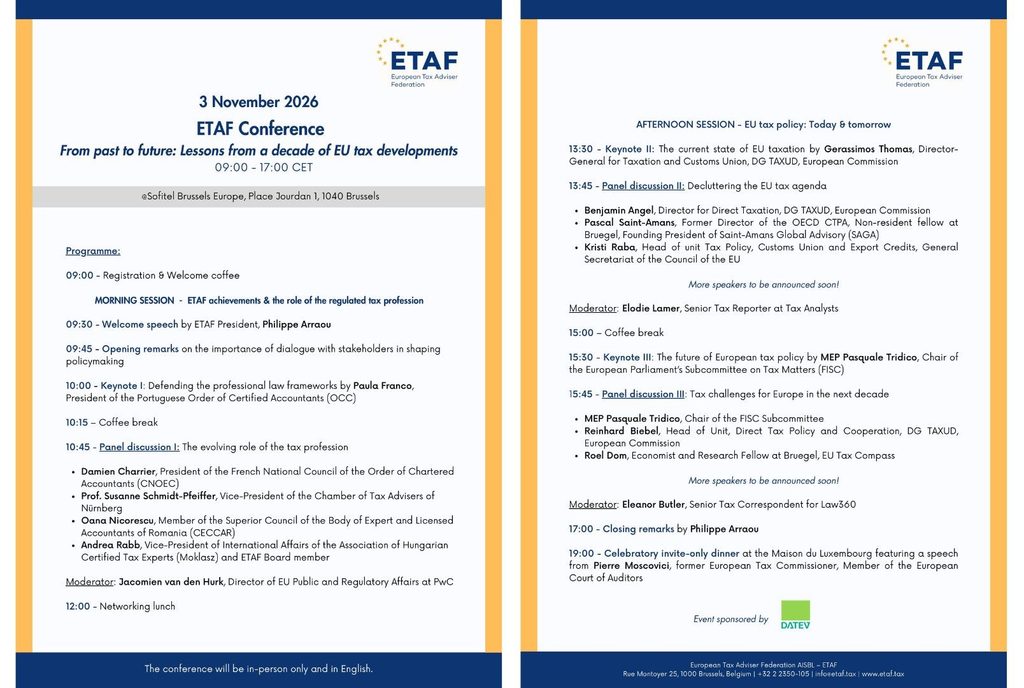
ETAF 10th Anniversary Conference: less than one month to go!
The event is in-person only and prior registration is required here.