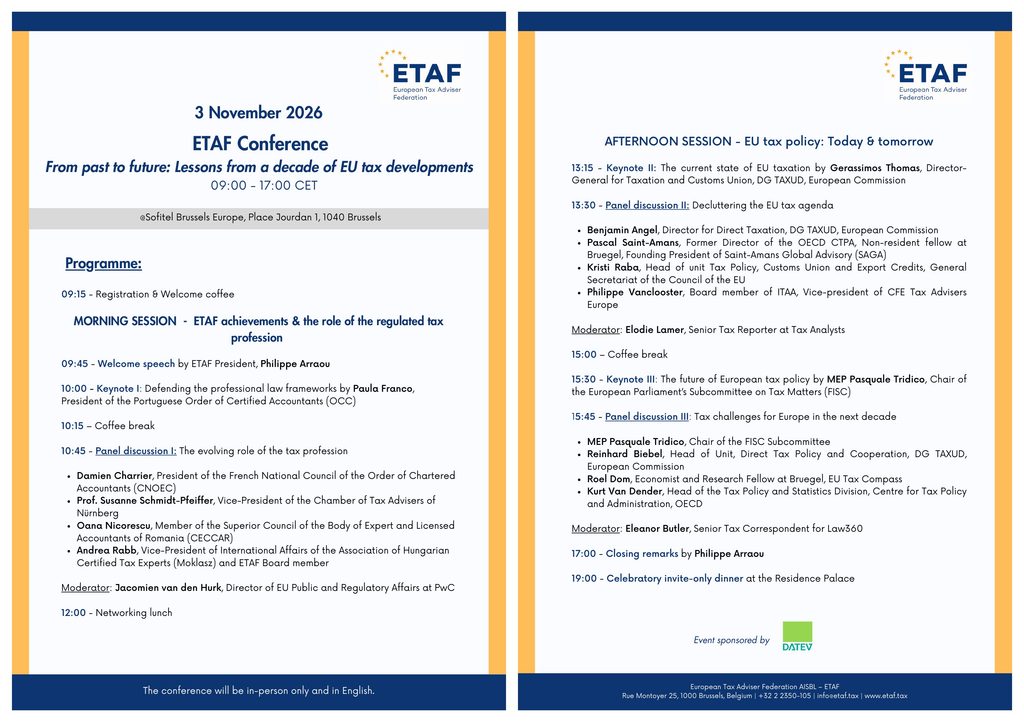
ETAF 10th Anniversary Conference on 3 November: see you tomorrow!
The event is in-person only and prior registration is required here.
Explore an interactive conference programme by clicking on the image below.
ETAF co-signs joint statement calling for genuine EU tax simplification
On 28 October 2026, ETAF co-signed a joint statement with 22 other professional, financial and business associations on the EU Tax Simplification Package that was published on 24 June 2026, comprising two proposals by the European Commission: the recast of the Directive on Administrative Cooperation (DAC) and the direct Tax Omnibus. Together, the signatories urge the Member States to reach agreement and stress that the outcome of the negotiations should be simpler than the current rules. The statement emphasises that the Commission’s proposed measures could save European businesses around €8 billion a year and contribute to the commitment of reducing administrative burdens by at least 25% for companies and 35% for SMEs. The signatories also make it clear that simpler rules do not equate to weaker enforcement, but rather to a more coherent EU tax framework, free from excessive administrative burden and duplication. While recognising that negotiations will need to address revenue, safeguards, and implementation, they stress that these considerations should not recreate the complexity the package seeks to remove.
Pillar Two tax revenues emerge as possible funding source in MFF negotiations
In the run up to the special European Council summit on 26–27 November 2026, where EU leaders plan to advance talks on the 2028–2034 Multiannual Financial Framework (MFF), the European Council President, António Costa, is reportedly considering using part of the revenues from the OECD Pillar Two global minimum tax to help fund the next EU budget. This idea comes amid continued disagreements over the Commission's five proposed new own resources, which are meant to reduce Member States’ national contributions to the EU budget. In particular, the Corporate Resource for Europe (CORE), which would require an annual lump-sum contribution from companies with an annual net turnover of over €100 million, has been met with significant resistance, particularly from Germany. Unlike CORE, which would be based on companies’ turnover, the alternative would draw on revenues from the 15% global minimum tax (GMT) on multinational profits. The proposal could have a significant impact on Member States that collect substantial GMT revenues, such as Ireland and the Netherlands. President António Costa is expected to have a discussion with the Member States on this option before presenting the updated budget figures and new own resource proposals at the November meeting.
Agenda of ECOFIN meeting on 9 November 2026
On 9 November 2026, EU Finance Ministers will hold a meeting of the Economic and Financial Affairs Council (ECOFIN). Based on the provisional agenda, the tobacco taxation package is listed as an item, a revision aimed at modernising the tobacco tax framework to align fiscal policy with current market dynamics and support public health objectives. Based on media reports, Sweden has requested that the item be removed from the agenda, arguing that because a new government has not yet been formed, it cannot currently adopt a position different from the one expressed at the 12 June ECOFIN meeting, where Sweden opposed the proposed minimum excise duties on tobacco-free nicotine pouches. Despite Sweden’s unresolved objections, the Irish Council Presidency aims to reach a political agreement on the proposed revisions, which further reduce the proposed minimum excise duties on nicotine pouches. Ministers will also exchange views on the economic consequences of EU legislation and the simplification, implementation and enforcement of existing EU rules, following a presentation of the Commission’s 2026 overview report and annual progress reports.
OECD/G20 Inclusive Framework sets out future tax priorities in joint statement
From 28 to 30 October 2026, the OECD/G20 Inclusive Framework on Base Erosion and Profit Shifting (BEPS) held its 18th plenary meeting in Paris to mark its 10th anniversary. In a joint statement, members reviewed a decade of progress, such as implementing BEPS minimum standards, creating the global minimum tax framework, and launching the recent Side-by-Side Package. They highlighted the need to lower compliance burdens and costs, improve tax administration, and strengthen dispute prevention and resolution. On Pillar Two, members discussed further simplification, the interaction of tax incentives and ongoing work such as developing the GloBE co-ordination mechanism. They also agreed to keep looking at tax issues from the digitalisation of the economy and asked the OECD Secretariat to prepare a work plan by the end of 2026. Members approved the next phase of work on taxing internationally mobile workers and discussed how tax policy relates to inequality, growth, and the possible use of artificial intelligence in tax administration. The Inclusive Framework plans to share more progress at its next plenary meeting in the first half of 2027.
The International Tax Observatory examines the design and revenue potential of windfall profit taxes in the EU
On 29 October 2026, the International Tax Observatory published a policy note entitled "Windfall Profit Taxes in the EU: Design and Revenues for Effective Implementation". The note looks at the various ways in which windfall profits (i.e. the profits that oil and gas companies make when commodity prices are very high) could be taxed. It draws on the experience of the EU's 2022 solidarity contribution and identifies several issues including a very narrow tax base, profit shifting and legal uncertainty. It proposes a permanent system which would kick in automatically when commodity prices exceed a certain threshold. It looks at three different tax bases: profits at the group level, domestic sales and increases in market value. The note expresses a preference for taxing apportioned consolidated profits as this would both prevent profit shifting and allow countries to tax based on actual economic activity. Based on a sample of the 56 largest oil and gas groups that are active in the EU, the note estimates that a 50% tax on consolidated windfall profits would raise €18 billion, a 2% tax on domestic sales would raise €10.2 billion and a 50% tax on market value gains would raise €23.4 billion.
FISC delegation examines how Denmark balances tax competitiveness and fairness
On 26 and 27 October 2026, a delegation from the European Parliament’s Subcommittee on Tax Matters (FISC), led by Chair Pasquale Tridico (The Left, Italy), visited Copenhagen to discuss the latest developments in Danish, European and international tax policy, particularly tax incentives, tax avoidance, and tax simplification. After the visit, Tridico explained that the mission tried to understand how Denmark combines high personal income tax and a low level of inequality whilst remaining competitive, with an efficient tax collection system and a relatively small shadow economy. He also mentioned an upcoming Danish tax reform that would introduce a 3% digital services tax, raise inheritance taxes and taxes on financial institutions, lower personal income tax for some households, and cut the corporate tax rate from 22% to 19%. Tridico said Denmark’s example shows that a simple, digital tax system and good public services can make people more willing to pay taxes. He stressed that Denmark should share its best practices with other EU Member States.
FISC and HOUS to hold joint public hearing on tax incentives for housing affordability
On 19 November 2026, from 10:00 to 11:30, the European Parliament’s Subcommittee on Tax Matters (FISC) and Special Committee on the Housing Crisis in the EU (HOUS) will hold a joint public hearing called “Affordability for first-time buyers and renters: Getting the balance right on tax incentives". With housing affordability remaining a challenge across the EU, the hearing will be looking at how taxation can be used to help people get into affordable homes, in particular first-time buyers and lower income households. Experts from the OECD and housing organisations will be present to discuss how tax incentives could be structured to assist these groups without necessarily driving up property prices or primarily benefiting the higher income groups. The discussion will cover a range of issues including transfer tax relief, the taxation of mortgages and targeted savings schemes.
OECD to hold public consultation meeting on revisions to Transfer Pricing Guidelines
After launching its public consultation in June 2026, the OECD will hold a meeting on 9 November in Paris and online to discuss proposed changes to Chapter VII of the OECD Transfer Pricing Guidelines for intra-group services. These revisions, published in June 2026, aim to clarify the guidance, align it with other chapters, and add more practical examples, while keeping the main transfer pricing principles the same. Topics will include the benefit test for intra-group services, shareholder activities, how to distinguish between services and intangible transactions, charging methods, allocation keys, and documentation requirements. The meeting will also review public comments on the proposals. The registration for virtual participation remains open until 4 November 2026.