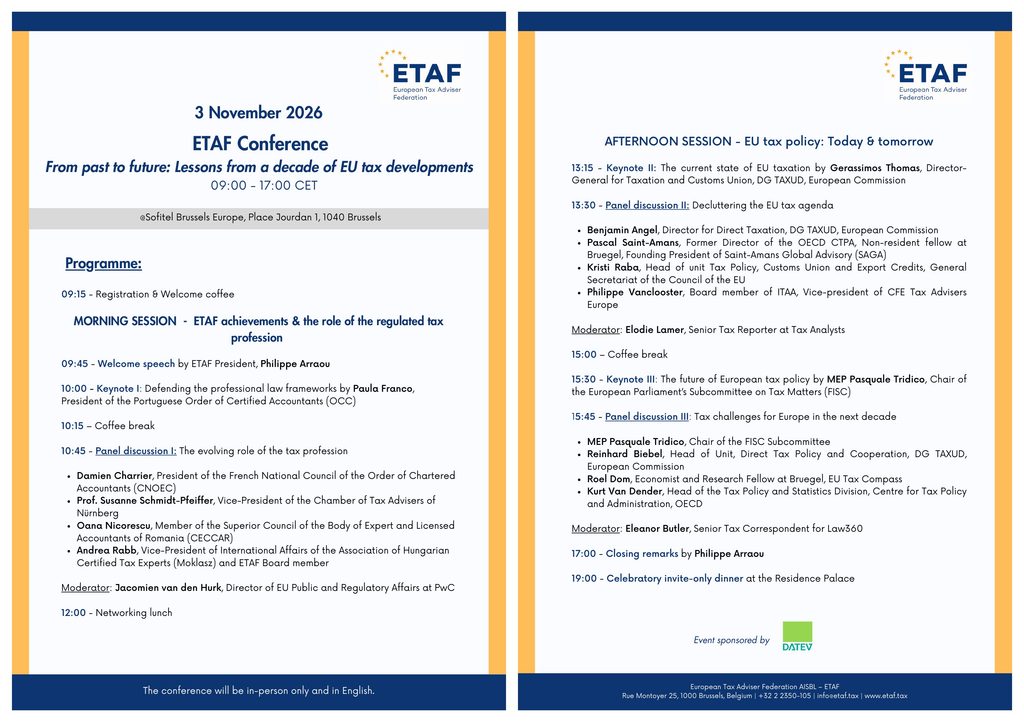
ETAF 10th Anniversary Conference on 3 November: one week to go!
The event is in-person only and prior registration is required here.
ETAF calls for safeguards on private equity ownership to keep tax advice independent
On 22 October 2026, ETAF published a new position paper on the rise of private equity (PE) investment in regulated tax advisory and accountancy practices. ETAF stresses that independence is an obligation of regulated tax advisers, not a privilege, and must not be compromised by PE investment. The paper outlines the risks of external investor influence in tax advisory and accountancy practices, such as reducing the quality of advice, conflicts of interest and putting confidential client data at risk. Rules restricting ownership and voting rights are therefore put in place to make sure that tax advice is guided by professional duties and the best interest of the client rather than by investor returns. ETAF therefore stresses that these rules should not be viewed as mere barriers to the Single Market, but as indispensable safeguards that protect independent professional judgement, taxpayers and the integrity of the tax system.
ETAF co-signs statement on effective EU AML implementation
On 21 October 2026, ETAF co-signed the joint statement “From rules to results: 6 priorities for effective EU AML implementation”, together with Accountancy Europe, the Council of Bars and Law Societies of Europe (CCBE) and CFE Tax Advisers Europe. The statement sets out the professions’ shared concerns about the draft regulatory technical standards (RTS) developed by the EU Anti-Money Laundering Authority (AMLA), in particular their implications for non-financial professions. The signatories recall that their professions have an important part to play in the fight against money laundering and terrorist financing. However, they warn that AMLA's current draft RTS risk creating a compliance paper trail rather than enabling the actual prevention and detection of financial crime. They therefore set out six key priorities: focusing on risks instead of the volume of data, avoiding regulating smaller firms out of the market, considering the real situation of non-financial professionals who do not hold client accounts or process payments as banks do, ensuring the rules are practical and legally sound, preserving professional judgement, and measuring success by how well financial crime is tackled. The signatories urge the European Commission and AMLA to take a step back, assess whether the draft RTS truly improve AML effectiveness, and amend them where needed.
Member States agree common position on 28th regime
On 23 October 2026, Member States’ ambassadors (Coreper) approved the Council’s negotiating mandate on the 28th regime, the optional EU-wide company form “EU Inc.”. The main point of contention was the EU employee stock option scheme (EU-ESO) under Article 79, which establishes a framework for the deferred taxation of warrants. Over the negotiations, at least 20 Member States objected to a tax rule in a non-tax file adopted by qualified majority, leading the Irish Presidency to narrow it: the provision now applies only to small mid-caps (fewer than 750 employees, turnover up to €150 million), drops the requirement of treatment no less favourable than national instruments, allows fair market value for manifestly undervalued sales and preserves national anti-abuse, tax residence and exit taxation rules. An annexed statement specifies that it sets no precedent for tax provisions in other acts. Other changes include stronger preventive controls, the option to refuse registration on anti-money laundering or criminal grounds, an optional employee participation mechanism for cross-border thresholds, the removal of the insolvency chapter and an implementation period of 21 months instead of 12. Trilogues will start once Parliament adopts its position, with the tax provision likely to remain contentious.
Council agrees its position on Digital Omnibus
On 21 October 2026, the Council of the EU agreed its negotiating position on the Digital Omnibus proposal, which covers data protection, privacy, data legislation and cybersecurity reporting. The Irish Presidency presented the agreement as a step towards lower administrative burdens and compliance costs, without weakening the protection of personal data and fundamental rights. On the GDPR, the Council keeps the current definition of personal data but clarifies pseudonymisation, simplifies some compliance obligations and adds safeguards for processing sensitive data in biometric verification and AI systems. It also backs longer deadlines for notifying personal data breaches, harmonised assessments of high-risk processing and easier use of data for scientific research. On e-privacy, cookie banners would be reduced by widening the cases in which consent is not needed, such as certain audience measurement and security purposes. The mandate further consolidates EU data rules, reinforces trade secret protection and allows higher fees for public-sector data reuse by very large companies and gatekeepers. For cybersecurity and data incident reporting, the Council replaces the Commission’s single EU entry point with national entry points, supported by an EU information point and harmonised notification rules. Trilogues will start once the European Parliament adopts its position, expected in Q1 2027.
MEPs call for better EU coordination to fight VAT fraud
On 20 October 2026, the European Parliament adopted its own-initiative report on combating VAT fraud and the effectiveness of cross-border cooperation. MEPs call for stronger anti-fraud safeguards in the next long-term EU budget, adequate resources for EU anti-fraud bodies, and common coordination rules backed by a single reporting system and digital tools that reduce the burden on smaller businesses. They want OLAF and the EPPO to have effective access to EU VAT and payment data. National authorities should share transaction data promptly through Eurofisc, and its analysis tools should use artificial intelligence to detect suspicious cross-border transactions in real time, they argue. MEPs insist that the review of the EU anti-fraud framework must lead to binding legislative changes, including clear information-sharing rules between OLAF and the EPPO. They also want rules ensuring that assets confiscated after EPPO investigations are returned to the EU budget, along with transparent reporting on the amounts recovered.
ECON draft report backs extension of EU anti-VAT fraud measures until 2030
In her draft report prepared for the European Parliament’s ECON committee and published on 22 October 2026, rapporteur MEP Aurore Lalucq (S&D, France) supports the Commission’s proposal to extend two EU anti-VAT fraud mechanisms, currently due to expire in December 2026, until 30 June 2030. The optional Reverse Charge Mechanism allows Member States to shift liability for VAT payment from the supplier to the customer in sectors prone to fraud, while the Quick Reaction Mechanism enables them to respond swiftly to sudden and large-scale VAT fraud. The extension aims to safeguard national tax revenues during the transition to the VAT in the Digital Age (ViDA) framework, which will introduce cross-border digital reporting requirements from July 2030. The rapporteur endorses the Commission’s proposal without amendments, describing the extension as a necessary and proportionate bridge towards stronger digital VAT enforcement across the EU. The ECON Committee is expected to debate the draft report on 3 November 2026, ahead of a plenary vote scheduled for 23 November 2026.
FISC delegation travels to Copenhagen
On 26 and 27 October 2026, a delegation of the European Parliament’s Subcommittee on Tax Matters (FISC), led by its Chair Pasquale Tridico (The Left, Italy) and composed of MEPs Luděk Niedermayer (EPP, Czechia), Pierre Pimpie (PfE, France) and Kira Marie Peter-Hansen (Greens/EFA, Denmark) will visit Denmark to discuss current developments in Danish, European and international tax policy in the areas of tax incentives, tax avoidance and tax simplification. MEPs will meet members of the Fiscal Affairs and European Affairs committees of the Danish Parliament and representatives of the Danish tax agency to discuss the digitalisation of the Danish tax system, personal income taxation and the Danish welfare state model, as well as ongoing EU files including the Taxation Omnibus package, the recast of the Directive on Administrative Cooperation (DAC) and energy taxation. The delegation will also meet stakeholders, experts and civil society representatives on the taxation of ultra-high-net-worth individuals, the implementation of the OECD Pillar Two global minimum tax and the “side-by-side” agreement aimed at ensuring the compatibility of Pillar Two with the US corporate tax regime.
FISC to hold public hearing on tax and the circular economy on 4 November
On Wednesday 4 November 2026, from 9:30 to 11:00, the FISC Subcommittee will hold a public hearing entitled “Closing the loop: how taxation can drive the circular economy”. The hearing will look at how EU tax policy, and VAT in particular, can better support the circular economy. Experts will discuss whether the current tax framework creates obstacles to re-use and waste reduction, how taxation could encourage more circular business models, and how such measures could be designed with due regard to their impact on businesses. The hearing takes place ahead of the European Commission’s forthcoming Circular Economy Act, which is expected to include tax-related measures, and coincides with the closing date of the Commission’s public consultation on its Circular VAT initiative, which runs until 4 November.
FISC to hold public hearing on tax and the circular economy on 4 November
On 22 October 2026, Advocate General at the Court of Justice of the European Union, Athanasios Rantos, delivered three opinions on the temporary solidarity contribution on fossil-fuel excess profits adopted in 2022 under Article 122(1) TFEU, which expired in October 2024, in cases brought by energy companies in Belgium (C-358/24), Ireland (C-533/24) and Italy (C-153/25). The question of the legal basis is reportedly closely watched by the European Commission, which has been reluctant to propose a new EU-wide windfall levy pending these cases, despite calls from six Member States for such a measure in response to the Iran war, and has so far only announced the creation of a working group. The AG acknowledged that the contribution is fiscal in nature but considered that Article 122(1), which does not require unanimity, does not generally exclude tax measures, that the levy pursued an emergency objective of financing crisis relief rather than harmonising tax policy, and that it did not circumvent ordinary legal bases. He also confirmed that Member States may extend the levy to other sectors and that limiting it to the largest companies on objective criteria does not constitute State aid.
OECD publishes revised GloBE Information Return XML Schema
On 22 October 2026, Advocate General at the Court of Justice of the European Union, Athanasios Rantos, delivered three opinions on the temporary solidarity contribution on fossil-fuel excess profits adopted in 2022 under Article 122(1) TFEU, which expired in October 2024, in cases brought by energy companies in Belgium (C-358/24), Ireland (C-533/24) and Italy (C-153/25). The question of the legal basis is reportedly closely watched by the European Commission, which has been reluctant to propose a new EU-wide windfall levy pending these cases, despite calls from six Member States for such a measure in response to the Iran war, and has so far only announced the creation of a working group. The AG acknowledged that the contribution is fiscal in nature but considered that Article 122(1), which does not require unanimity, does not generally exclude tax measures, that the levy pursued an emergency objective of financing crisis relief rather than harmonising tax policy, and that it did not circumvent ordinary legal bases. He also confirmed that Member States may extend the levy to other sectors and that limiting it to the largest companies on objective criteria does not constitute State aid.