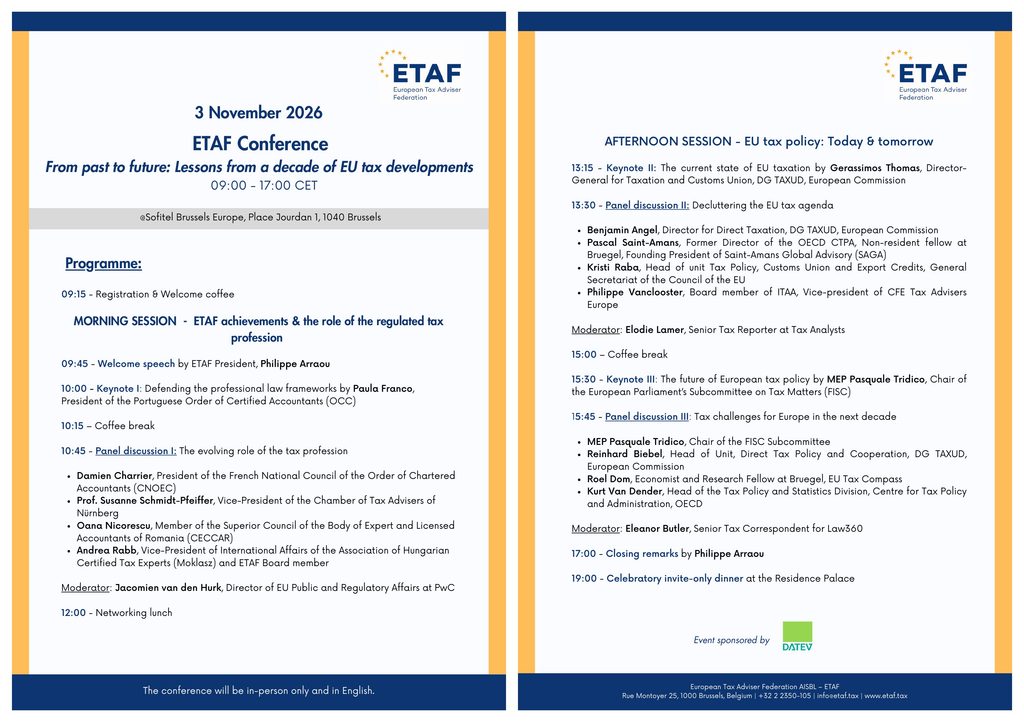
ETAF 10th Anniversary Conference on 3 November: final programme is out!
The event is in-person only and prior registration is required here.
EU leaders remain divided on 2028–2034 MFF, talks to continue at special summit in November
At the European Council of 15–16 October 2026, EU leaders failed to make progress on the 2028–2034 Multiannual Financial Framework (MFF), after hours of talks that were also reportedly derailed by a three-hour dispute over taxing car emissions. Discussions were based on the revised proposal of the Irish Council Presidency, which reduces the Commission’s €1.76 trillion proposal to €1.62 trillion, with cuts mainly affecting external action, budgetary safety margins, research, climate, clean transport, energy interconnections and competitiveness, while increasing funding for agriculture and rural development. The proposal was criticised by the “frugal” Member States led by Germany, alongside the Netherlands and Sweden, which call for cuts of several hundred billion euros; France, which opposes major cuts and conditions any agreement on substantial new EU-wide taxes; and the “Friends of Cohesion”, seeking more support for agriculture and regional development. As Member States continue to oppose the Commission’s five proposed own resources, European Council President António Costa pledged to examine the European Parliament’s proposals for levies on crypto firms, online gambling and large tech companies, which were left out of the Irish proposal, as well as a Greek idea to channel future 6G spectrum sales to the EU budget, noting that new revenue could reduce national contributions. With elections in France, Italy, Poland, Greece, Estonia, Finland and Slovakia in 2027, leaders aim for a deal by the end of the year, with a special summit on 26-27 November 2026, ahead of which António Costa will circulate new figures, and a final round at the European Council of 17–18 December 2026. In the conclusions published at the end of their meeting, EU leaders only ask the Irish Presidency to advance negotiations on the file, whilst recalling that the adoption of relevant legislative acts in 2027 is necessary for funding to be disbursed already in 2028.
European Commission to issue a Recommendation on tax rules fit for modern ways of working
The European Commission is preparing a Recommendation on “Tax rules fit for modern ways of working”, planned for adoption in Q3 2027. The initiative responds to the challenges and opportunities that the cross-border mobility of individuals, and the growing use of technology to work remotely and across borders, present for individuals, businesses and governments alike. It aims to address tax obstacles that prevent businesses from recruiting and retaining talent across borders and deter individuals from taking up cross-border jobs, thereby limiting labour mobility and preventing both businesses and individuals from fully benefiting from the Single Market. The Commission will publish a call for evidence to gather stakeholder input ahead of the Recommendation.
ECON draft report on DAC recast proposes to retain DAC6 reporting for Pillar Two groups
On 15 October, the European Parliament’s Economic and Monetary Affairs Committee (ECON) published its draft report on the recast of the Directive on Administrative Cooperation (DAC), prepared by rapporteur Francisco Assis (S&D, Portugal). While supporting simplification, the rapporteur stresses that it should not come at the expense of tax transparency and proposes to delete the carve-out from DAC6 reporting for multinational and domestic groups subject to the global minimum tax rules, arguing that practical experience with Pillar Two and its interaction with DAC6 remains limited and that premature removal of the reporting obligation would create an information gap for tax authorities. The report also regrets that the recast does not build on the withdrawn Unshell Directive and proposes to incorporate selected economic substance criteria directly into hallmark D2, rather than deferring this to a Council implementing act as suggested by the Commission. The rapporteur further proposes deleting the anti-gold-plating provision in Article 1(4), which would bar Member States from maintaining domestic reporting obligations that substantially duplicate DAC requirements and to strengthen the Directive’s feedback and review mechanisms. The deadline for amendments on this report is 12 November 2026, with the committee vote scheduled for 14 January 2027 and the plenary vote expected in February 2027.
MEPs and national MPs debate wealth taxation and the tax dimension of “EU Inc.”
On 12 October, the European Parliament’s Subcommittee on Tax Matters (FISC) held an interparliamentary committee meeting with national parliamentarians and experts from the International Tax Observatory, the Centre for Social and Economic Research (CASE) and the Finnish and Luxembourg tax administrations. The first session addressed wealth concentration and the taxation of ultra-high-net-worth individuals. The International Tax Observatory presented its proposal for a 2% minimum tax on the wealthiest individuals, and Members debated the division of competences between the EU and national levels, exit taxation, unrealised capital gains, tax rates and the risk of loopholes. Some Members warned of risks to competitiveness and of capital flight, which experts said was poorly evidenced where such taxes already exist. The discussion will feed into FISC’s own-initiative report on the topic. The second session examined the tax aspects of the Commission’s 28th regime proposal, “EU Inc.”. Experts called for a one-stop-shop tax dimension to help start-ups grow within the EU, but some feared the proposal amounted to deregulation. Members raised concerns about national specificities, the circumvention of unanimity, and competition between national and EU regimes. Speaking for the Commission, Reinhard Biebel stressed the once-only reporting principle and confirmed that the BEFIT proposal remains on the table. Speakers further highlighted unresolved cross-border issues such as loss relief and transfer pricing, as well as national differences in the treatment of employee stock options. The meeting can be re-watched here.
ECJ clarifies scope of EU anti-abuse rules in dividend transaction chains
On 15 October, in its judgment in Case C-203/25, the European Court of Justice (ECJ) clarified the scope of the anti-abuse provision in Article 1(2) and (3) of the Parent-Subsidiary Directive (PSD), concerning the question of whether the withholding tax (WHT) exemption on dividends can be denied where a parent company participates in a potentially abusive chain of transactions, even though it carries out genuine economic activities and is not a conduit company. The Court held that the anti-abuse provision in the PSD may apply to a chain of transactions, all or some of which are not genuine, even where the company carries out actual economic activity and is not a conduit company itself. It was also clarified that tax authorities can consider transactions that were carried outside their Member State, even if the tax advantage does not arise at the level of the subsidiary but at the level of the ultimate beneficiary. Also, the subsidiary does not need to be aware of the abusive arrangement, and it is enough that one participating group company or the ultimate beneficiary was or could have been aware of it.
New Eurobarometer survey highlights growing use of AI in European companies
European businesses increasingly rely on artificial intelligence (AI), according to the latest Eurobarometer survey, published on 14 October. The survey also covers algorithmic management (AM), defined as digital systems, AI-powered or not, that help managers organise the workforce or support decisions on tasks, schedules, performance or staffing. 42% of the SMEs and mid-caps surveyed already use AI and AM, mostly in a limited and experimental way, and a further 21% plan to do so. The most common uses are customer service and client relations (47%), monitoring performance and productivity (36%), and logistics, planning and staff scheduling (30%). A clear majority (61%) say AI helps them take decisions, and 75% expect AI and AM to improve job quality. 90% report that people take the decisions, while only 2% of decisions are fully automated. More information is available in the European Commission’s press release.
OECD report on enhancing corporate tax systems to support business dynamism
On 15 October, the OECD published a report on how corporate income tax (CIT) systems can support business dynamism, investment and growth, as firm entry, job reallocation and employment in young firms have declined across many advanced economies over the past two decades. The report finds that CIT rates can discourage firm entry, while firm exit appears less sensitive to them. Smaller, younger and financially constrained firms are the most affected, so neutrality with respect to firm size, age and business model is important. The report also finds that excessive complexity and compliance costs weigh disproportionately on small firms, reduce the take-up of incentives and raise the cost of international expansion, which makes simple, stable and predictable rules essential. The international tax agenda can support a level playing field, but additional burdens on multinationals may limit productivity spillovers. Non-tax factors such as competition, insolvency regimes, access to finance, innovation and labour markets remain key drivers of dynamism, it states. The report calls for further research on tax effects across the firm life cycle, firm exit and international expansion. More details about the OECD work on this topic are also available in the OECD Secretary‑General Tax Report to G20 Finance Ministers and Central Bank Governors.
OECD Tax Certainty Day 2026
The OECD will hold its Tax Certainty Day on 4 November 2026, from 9:30 to 17:30 CET, in hybrid format at the OECD Boulogne-Billancourt (France) premises and online. The event will allow tax policymakers, tax administrations, business representatives and other stakeholders to assess the tax certainty agenda and work towards further improvements in dispute prevention and resolution. The 2025 Mutual Agreement Procedure (MAP) and Advance Pricing Arrangement (APA) Statistics will be released and the 2025 MAP & APA Awards presented. The programme also includes a fireside chat and panels on why tax certainty matters, dispute prevention in an evolving international tax landscape, and the future of MAP and APA administration. Participants must hold a MyOECD account and submit their request by 26 October 2026, using the Zoom pre-registration form for virtual attendance or the in-person pre-registration form for attendance on site.