Main highlights from the State of the Union address
On 16 September 2026, European Commission President Ursula von der Leyen delivered her annual State of the Union address, setting out the Commission’s priorities for the year ahead. On competitiveness, she announced plans to complete the Single Market overhaul by next year, building on the “One Europe, One Market Roadmap”, alongside a new pact against gold-plating and a Banking Package focused on simplification and reducing fragmentation. Other announcements covered critical raw materials, AI, social policy, security, defence and support for Ukraine, as well as a proposal for Canada to become the EU’s first associate member. During the debate, EPP MEP Siegfried Mureșan proposed an EU digital levy on large technology companies as an EU own resource, while Greens/EFA Co-Chair Terry Reintke called for a windfall profit tax on energy companies. The full address and debate are available for replay here.
European Commission unveils its Skills portability initiative
On 15 September 2026, the European Commission published its Fair Labour Mobility Package, which includes several measures to facilitate cross-border labour mobility. Of relevance for regulated professions are three legislative proposals. The proposal for a Skills Portability Act would introduce EU-wide digital qualification credentials and improve qualification information through Europass. A revision of the Professional Qualifications Directive would introduce a digital recognition procedure and procedural changes, including shorter deadlines, limited documentation and cost-based fees. National access requirements would remain unchanged. The Commission also plans greater use of Common Training Frameworks, which set common minimum standards and can enable automatic recognition across Member States. A new proposed Directive on the recognition of qualifications of third-country nationals would introduce common recognition rules, with tax professionals falling under the general system based on individual assessment.
Member State raise concerns over scope and impact of Tax Omnibus
On 5 October, the Council’s Antici group on simplification will discuss the Tax Omnibus proposal on direct taxation. Based on comments submitted after the Group’s 13 July meeting, it has been reported that several Member States consider that the proposal goes beyond its stated simplification objective. Concerns focus on the removal of minimum holding requirements under the Interest and Royalties and Parent-Subsidiary Directives, which would abolish withholding taxes on cross-border payments of dividends, interest and royalties between EU companies. Delegations warned this could reduce national tax revenues and affect source-state taxing rights under bilateral tax treaties. Questions were also raised over the proposed R&D allowance under ATAD and the new “non-derogation clauses” for the interest limitation and CFC rules. Some Member States consider the latter inconsistent with ATAD’s minimum-standard approach and fear they could require stricter national anti-abuse rules to be removed.
European Parliament gives final approval to customs reform as Commission prepares e-commerce handling fee
On 16 September, the European Parliament gave its final approval to the reform of the Union Customs Code, following a plenary debate with Trade Commissioner Maroš Šefčovič on 14 September. The reform introduces new rules for e-commerce imports, including a handling fee on goods ordered directly from non-EU countries and sent to EU consumers, alongside the EU Customs Authority and Customs Data Hub. During the debate, Šefčovič reiterated that the new e-commerce handling fee is due to apply from 1 November 2026. The European Commission is expected to publish a draft delegated regulation by the end of September setting the amount and scope of the fee. According to a draft circulating in the press, an amount between €2 and €4 is under consideration, with the final figure still to be agreed. The draft indicates that the fee would cover customs authorities’ direct and indirect costs related to processing e-commerce imports, including data processing, risk analysis, controls and infrastructure. Because this range is still shown in brackets, it signals that discussions are not yet finalised, though most observers anticipate the final figure will land closer to €2.
Code of Conduct Group to review EU tax list and Member State tax measures
The Code of Conduct Group (Business Taxation) of the Council of the EU will meet on 22 September to prepare the next update of the EU list of non-cooperative jurisdictions for tax purposes. According to the provisional agenda, discussions will include the draft Code of Conduct Group report and draft Council conclusions accompanying the update. The Group is also expected to continue its scrutiny of Member States’ tax practices, including whether new measures comply with the Code’s standstill commitments, the monitoring of highly mobile activities in special economic zones and the assessment of individual measures in practice. Members will also appoint Vice-Chairs and elect a new Chair, while considering the Irish Presidency’s work programme for the Group.
New Director appointed at the European Commission’s DG TAXUD
On 17 September, the European Commission appointed Anne-Françoise Mélot as Director for Resources and General Affairs in the Directorate-General for Taxation and Customs Union (DG TAXUD). Mélot currently serves as Head of Unit for IT, Finance and Internal Control in DG FISMA and has more than 25 years of experience in the Commission. Her starting date will be announced at a later stage.
FISC delegation to travel to Washington, D.C. and Wilmington
A delegation from the European Parliament’s FISC Subcommittee will visit Washington, D.C. and Wilmington (Delaware), from 21 to 23 September 2026. Led by MEP Luděk Niedermayer (EPP, Czechia), the group of MEPs will hold meetings with representatives from major US institutions, including the Department of the Treasury, Congress, the Council of Economic Advisors, and the Internal Revenue Service, alongside private-sector stakeholders, experts, and civil society representatives. A central focus of the visit will be EU-US tax relations, particularly the parallel implementation of the OECD's Pillar Two reform and the US GILTI/NCTI minimum corporate tax regime. The delegation will also address ongoing negotiations on a new global framework for digital taxation, efforts to strengthen tax competitiveness, and measures to combat tax evasion and avoidance.
81st CNOEC Congress gathers in Paris to rethink the tax profession
The 81st Congress of the French Conseil National de l’Ordre des experts-comptables (CNOEC) took place from 16 to 18 September at Paris Expo Porte de Versailles, under the theme “[Re]fondation des cabinets: environnement – valeur – compétences”. The Congress, which gathered 8 500 participants, addressed the simultaneous transformations facing accountancy firms, including e-invoicing, automation and artificial intelligence, changing client expectations, evolving business models and skills needs. The programme was structured around five areas: professional regulation, client relations and experience, value proposition, skills and management, and e-invoicing and AI. Speakers included CNOEC President Damien Charrier, Public Accounts Minister David Amiel, SMEs Minister Serge Papin, DGFiP Director-General Amélie Verdier, MEP Stéphanie Yon-Courtin, economist Philippe Aghion and political scientist Asma Mhalla. The four Congress rapporteurs focused on adapting firms’ services and organisation to digitalisation while preserving professional regulation and the core principles of the profession. ETAF President, Head of office and Secretariat all attended the event. The Congress’ work will be summarised in a publication to be released in November.
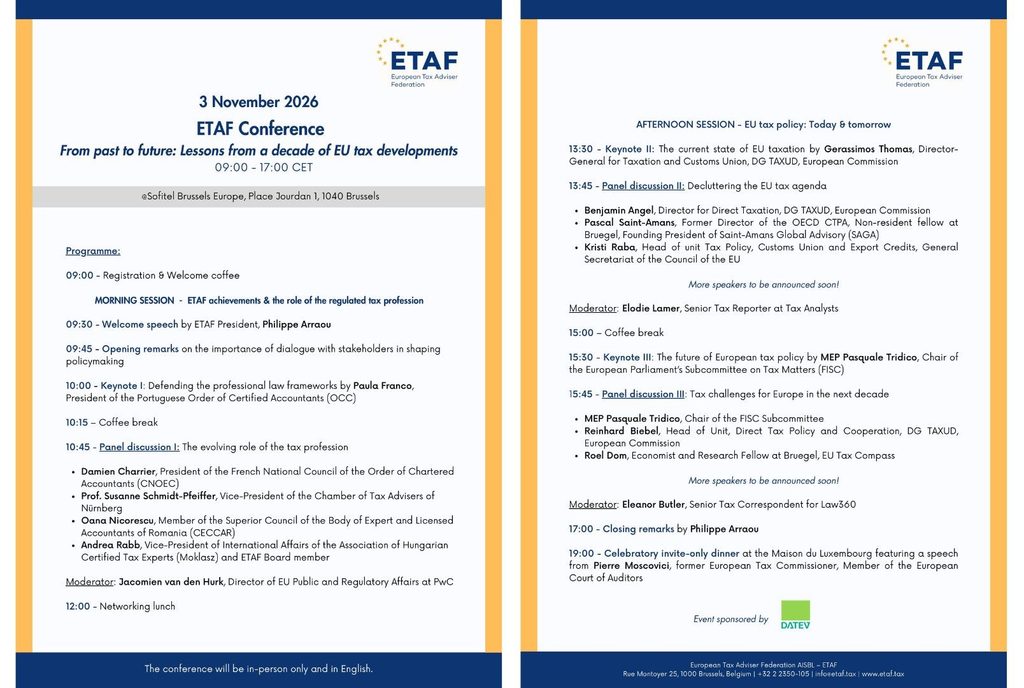
ETAF 10th Anniversary Conference on 3 November 2026: more speakers announced!
The event is in-person only and prior registration is required here.