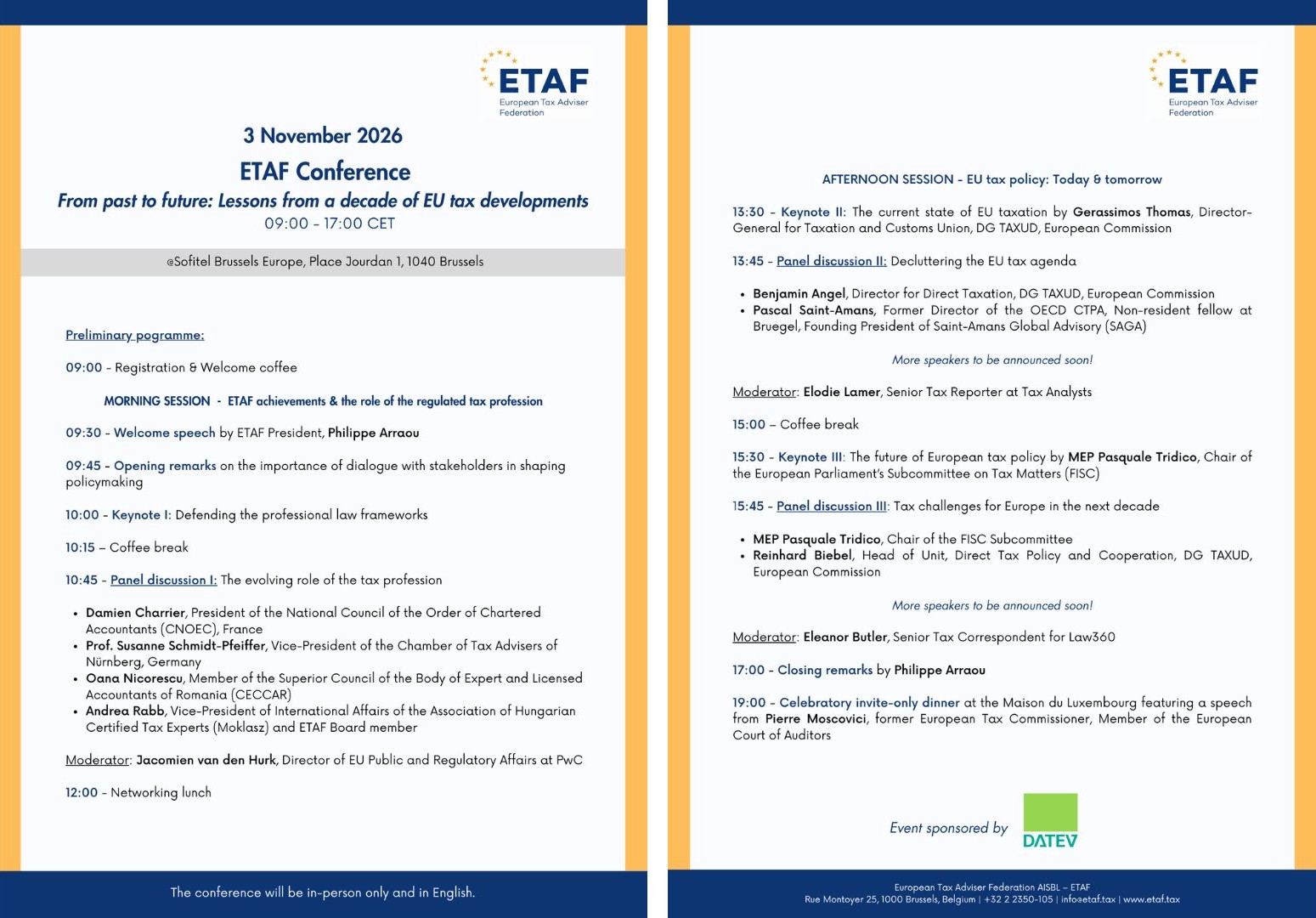
ETAF 10th Anniversary Conference on 3 November 2026: programme announced!
The event is in-person only and prior registration is required here.
First compromise text on the DAC recast discussed
The Council Working Party on Tax Questions (Direct Taxation) discussed on 4 September a first draft compromise text on the recast of the Directive on Administrative Cooperation in tax matters (DAC). On the changes to DAC6, the compromise text reportedly proposes to delay the application of the DAC6 carveout for Pillar 2 companies from 2028 to 2031. Under the text, prepared by the Irish Presidency of the Council of the EU, the Commission would be required to assess the suitability of the carveout by the end of 2029 and could subsequently propose to amend or repeal it. The draft text also removes the Commission’s proposed exclusion of companies covered by the OECD Pillar 2 side-by-side regime from the carveout. Moreover, rather than developing new economic substance criteria through a Council implementing act, the Commission would report within five years on the feasibility of options to further develop the applicable criteria, reflecting Member States’ reservations about the original approach. The Irish Presidency of the Council of the EU is keen to move quickly on this file, with an agreement envisaged by December.
European Commission defends proposed CFC carveout in Tax Simplification Omnibus
On 3 September, the Council’s Antici group on simplification discussed the Tax Simplification Omnibus. In a document prepared for the meeting and responding to questions from Member States, the European Commission reportedly defended its proposed Pillar 2 carveout from the Anti-Tax Avoidance Directive (ATAD) CFC rules. The Commission stressed that the carveout should ensure that companies remain subject either to Pillar 2 or to CFC rules, preventing opportunities for aggressive tax planning or avoidance. It explained that US-headquartered multinationals under the side-by-side regime would benefit from the carveout for their EU intermediate parent companies only where their CFCs are subject to a Qualified Domestic Minimum Top-up Tax (QDMTT). This, the Commission argued, would ensure a level playing field and prevent gaps where neither Pillar 2 nor CFC rules apply to low-taxed profits. The Commission also maintained that the carveout is not premature, despite the recent introduction of Pillar 2, as the overlap with CFC rules is already apparent, and that it should not create significant profit-shifting risks given current corporate tax rates in EU Member States.
Bruegel discussion: What role can tax systems play in bolstering European competitiveness?
On 2 September, as part of its Annual Meetings 2026, Bruegel organised a discussion on the role of tax systems in strengthening European competitiveness, featuring Gerassimos Thomas, Director-General for Taxation and Customs Union at the European Commission, Fabrizia Lapecorella, Deputy Secretary-General of the OECD and Rocío Bermúdez Becerra, Transfer Pricing and Tax Policy Senior Manager at Repsol, moderated by Pascal Saint-Amans, Senior Fellow at Bruegel. The discussion highlighted tax simplification and competitiveness as key EU priorities, with Mr Thomas stressing the need to reduce regulatory burdens while maintaining effective tax collection through a more risk-based and technology-driven approach. The proposed 28th regime was welcomed by the Commission and the OECD as a step towards reducing the burden of 27 national tax systems, while well-designed loss-offset rules and refundable or carry-forward R&D incentives could further support business dynamism, Ms Lapecorella noted. Ms Bermudez Becerra stressed the importance of simplicity, legal certainty, predictability, eliminating double taxation and effective tax incentives, while warning against adding new layers of complexity. In the afternoon, ETAF participated in a closed-door workshop, “Simplifying EU Taxation: Balancing Competitiveness and Fairness”, as part of the EU Tax Compass project, a new branch of the EU Tax Observatory led by Bruegel.
EP JURI committee advances work on the 28th corporate legal regime
The European Parliament’s JURI Committee is advancing negotiations on the proposed 28th corporate regime, with amendments due to be considered on 7 September. Rapporteur MEP René Repasi (S&D, Germany) is targeting a committee vote on 8 October, followed by a plenary vote later that month. Negotiators have reportedly made progress on an initial draft of compromise amendments, incorporating the rapporteur’s proposed amendment to the scope of the regulation, which aims to cover two categories of companies: a new harmonised legal form of limited liability company (EUInc.) provided for under the law of each Member State and a new legal form for steward-ownership companies, whose governance prioritises social or environmental objectives over short-term financial returns. The draft endorses the rapporteur’s proposal to broaden employee participation by introducing an employee stock ownership plan (ESOP) alongside a stock option plan (ESO), while also incorporating social safeguards, including a provision stipulating that the EU-ESOP must not be used as a substitute for remuneration or statutory minimum wages. Moreover, MEPs propose stronger checks by competent authorities, including compliance with EU and national anti-money-laundering rules. Meanwhile, the Council of the EU reviewed its first compromise draft on 1 September, with further meetings scheduled for 10 and 17 September, followed by a ministerial political debate on 24 September.
Council greenlights EU Customs Reform
On 3 September, the Council of the EU gave its final approval to the EU Customs Reform, introducing new tools to facilitate trade, improve customs revenue collection and strengthen controls. The updated Union Customs Code clarifies that non-EU e-commerce platforms will be treated as importers and become responsible for customs formalities and duties. An EU-wide handling fee on small parcels, whose amount still has to be set via a delegated act, will also be introduced by 1 November 2026, separately from the removal of the €150 customs duty exemption. The reform establishes a new EU Customs Authority and a central EU Customs Data Hub to improve risk analysis and coordination. It also creates a “Trust and Check” trader status offering simplified procedures to compliant businesses. The European Parliament is expected to approve the text later in September, with the data hub becoming mandatory for e-commerce businesses from July 2028 and for all traders from March 2034.
Swedish election risks delaying agreement on Tobacco Taxation Directive
At its meeting on 14 September, the Working Party on Tax Questions is reportedly expected to make only limited progress on revising the Tobacco Taxation Directive, as Sweden’s 13 September election could leave Stockholm without a clear negotiating position. The proposal would expand the scope of the directive to new products and impose higher minimum tax rates across the board for in-scope products. Negotiations made progress under the Cyprus Presidency of the Council of the EU but have since stalled over Sweden’s opposition to extending taxation to nicotine pouches, amid its longstanding defence of traditional snus. The election and potentially prolonged coalition negotiations could complicate efforts by the Irish Council Presidency to reach an agreement in October, as initially envisaged, and could ultimately lead Sweden to abstain in a vote at the 9 October ECOFIN meeting.
Tax dimension of online gambling under EU scrutiny
A new ECIPE study published on 2 September argues the EU should raise own resources for its next Multiannual Financial Framework through a national contribution based on online gambling, modelled on the existing plastic waste levy, estimating it could raise up to €5 billion annually by 2030. On 3 September, in a written answer to MEPs Bruno Gonçalves and Laura Ballarín Cereza on how the taxation of cross-border digital gambling operators could be improved to ensure they pay a fair share of taxes where their consumers are located, Commission Executive Vice-President Séjourné said the Commission continues to encourage Member States to strengthen administrative cooperation between tax authorities, including the exchange of tax information and use of the Central Electronic System of Payment Information for VAT purposes, adding that taxation involves different collection models across the supply chain and that how these operate in the internal market is under examination, with a dedicated study planned.
Countries seek flexibility in draft UN digital tax protocol
According to inputs on Workstream II (taxation of services) submitted to the committee negotiating the draft framework convention and two early protocols, at least 18 mostly European countries reportedly called for greater optionality and flexibility in the protocol. Their concerns range from the protocol’s tax base and scope to its interaction with existing tax treaties and the lack of clarity around the creation of new nexus rules. Although the protocol would be optional for countries signing the UN framework convention on international tax cooperation, some countries are advocating for reservations that would allow them to select which provisions to apply and which to exclude. The draft protocol would cover income from cross-border services, including service fees, automated digital services and insurance premiums, earned by individuals, companies or groups where the income is derived from a resident of a signatory state. It would also allow a state party to impose a gross-basis tax on income arising in its territory where the beneficial owner is resident in another state party. All the inputs can be consulted here.