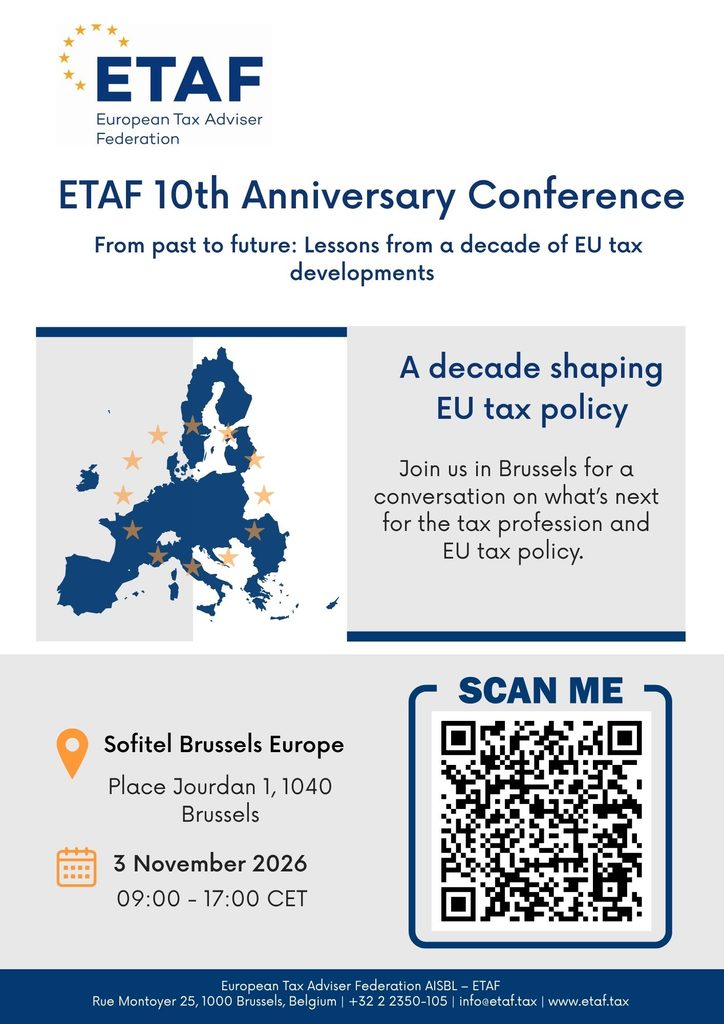
ETAF 10th Anniversary Conference: registration is now open!
In 2026, the European Tax Adviser Federation (ETAF) celebrates its 10th anniversary, marking a decade of active engagement at the heart of EU tax policy and of championing the independence and professional standards of regulated tax advisers across Europe. To mark this milestone, ETAF will convene a high-level, one-day symposium in Brussels on 3 November 2026, bringing together leading voices from the European institutions, Member States, academia and the tax profession for a forward-looking discussion on the evolving role of the regulated tax profession and the future of EU tax policy. The symposium will be followed by an invitation-only anniversary dinner at the Maison du Luxembourg, featuring a speech by Pierre Moscovici, former European Commissioner for Taxation (2014–2019) and currently a member of the European Court of Auditors. The event is in-person only and prior registration is required here.
Main outcomes of UN’s fifth tax negotiating session
The UN’s Intergovernmental Negotiating Committee concluded its fifth negotiating session on 13 August, marking the first time delegates worked from complete drafts of the proposed Framework Convention on International Tax Cooperation and two early protocols. Major divisions remain over taxing rights, existing tax treaties and the flexibility countries should have when joining the protocols. Concerning the Framework Convention, developing countries are seeking stronger source- and market-country taxing rights, while many European and other developed countries favour a framework that complements existing international tax rules and preserves legal certainty. European countries notably stressed that the future Conference of the States Parties should not have the power to impose new tax obligations on member states. Article 5 of the draft Convention remains particularly contentious, with developing countries pushing for broader taxing rights based on markets, users, revenues and data, while developed countries warn that overlapping nexus rules could lead to multiple taxation. Article 21 is also disputed, as developing countries want existing tax treaties progressively aligned with the Convention, while many European countries oppose an obligation to renegotiate them. Protocol I on cross-border services and digital taxation remains contentious over optionality, sourcing rules, tax rates and the treatment of digital services taxes, with developing countries also seeking explicit coverage of AI-related services. Protocol II on dispute prevention and resolution has seen greater convergence around mutual agreement procedures, but countries remain divided over whether the UN mechanism should supplement or replace existing treaty arrangements. Revised drafts are expected ahead of the sixth negotiating session in Nairobi, scheduled from 30 November to 10 December 2026.
CORE proposal back on the table
The European Commission is reportedly considering adjustments to the proposed Corporate Resource for Europe (CORE) as part of negotiations on the EU’s next seven-year budget. The changes could narrow the scope of the levy by exempting less profitable companies and increasing the €100 million turnover threshold, potentially reducing its impact on SMEs and sectors facing lower margins. CORE, as initially proposed, would apply an additional 0.1% charge to companies operating in the EU with net turnover above €100 million, with concerns raised about its competitiveness effects and the fairness of taxing turnover rather than profits. The Commission is reportedly also assessing the treatment of foreign companies to ensure compatibility with international trade rules. Discussions on CORE are taking place alongside negotiations on other potential EU own resources, including CBAM, e-waste, tobacco, digital, crypto and online gambling levies. Ireland, which is currently holding the rotating Presidency of the Council of the EU, is reportedly preparing to put forward a new tax package ahead of the EU leaders’ summit in October and is therefore holding bilateral meetings with Member States to gauge support for the eight taxes under consideration. The outcome of those discussions could help shape the Commission’s revisions to CORE.
EU windfall tax on oil companies regains momentum
Six EU countries are calling for talks on an EU-wide tax on windfall profits earned by oil companies amid surging energy prices linked to Iran’s blockade of the Strait of Hormuz. In a letter sent on 21 August 2026, Germany, Spain, Portugal, Italy, Poland and Austria have reportedly asked the Irish Presidency to put the issue on the agenda of the EU Finance Ministers’ informal meeting in Dublin on 18 and 19 September. The signatories say the EU was facing one of its biggest supply shocks in decades and that rising energy costs were increasing pressure on households and businesses. Oil prices have risen about 25% since the outbreak of the U.S.-Israeli war on Iran, while European diesel prices have climbed more than 70% and gasoline around 20%. They call for a common framework to tax windfall profits, drawing on lessons from measures introduced in 2022. The six countries also urge the EU to publish its investigation into refinery margins to ensure refiners are not exploiting the energy price spike. The Irish Council presidency confirmed it will discuss a way forward with these countries.
European Commission publishes additional CBAM guidelines
On 24 August 2026, the European Commission issued a guidance document covering Carbon Border Adjustment Mechanism (CBAM) verification and accreditation for verifiers and National Accreditation Bodies. The document clarifies the rules for verifiers intending to verify emissions reports of operators of installations producing CBAM goods outside the EU that are imported from 1 January 2026. It also lays down the requirements applicable to National Accreditation Bodies (NABs) performing accreditation and surveillance of such verifiers. The guidance aims to help CBAM verifiers, as they will need to register in the CBAM Registry within two months of receiving their CBAM accreditation. The Commission has also published a procedure setting out how CBAM verifiers can obtain access to the CBAM Registry as from 1 September 2026.
EDPS opinion on the DAC recast
On 17 August 2026, the European Data Protection Supervisor (EDPS) issued its opinion on the proposed recast of the Directive on administrative cooperation in taxation (DAC). The EDPS supports the initiative, highlighting its potential to strengthen data protection safeguards and provide greater legal certainty for taxpayers and tax authorities. It recommends retaining “foreseeable relevance” as a key principle for information exchanges and clarifying how the receiving Member State is identified for tax-residence purposes. The EDPS also welcomes a stronger feedback mechanism to improve data quality and states that it should address both systemic issues and individual cases, including mismatches, duplicated data, or information not relevant to the framework's purposes. Access to financial and AML databases should remain necessary and proportionate, with clear safeguards, it further stresses. Finally, the EDPS calls for statistical use of exchanged data to rely on anonymised or aggregated information and recommends setting data-subject rights restrictions directly in the DAC recast rather than leaving them broadly to Member States.
AMLA public consultation on harmonised risk assessment methodology for the non-financial sector
The Anti-Money Laundering Authority (AMLA) is currently conducting a public consultation on draft Regulatory Technical Standards (RTS) under Article 40(2) of Directive (EU) 2024/1640 (AMLD6), which will determine how supervisors across the EU assess the money laundering and terrorist financing risk of obliged entities in the non-financial sector, including tax advisers, on a harmonised basis. The draft RTS applies tailored data points depending on the activity concerned, with Annex I setting out a reduced set of 12 data points for small firms and a fuller set of 34 for other firms, covering firm structure, customer base, services, geographical exposure and client interaction, from which supervisors would calculate an inherent risk score, while Annex II adds further questions on AML/CFT controls for all firms above the small-entity threshold, feeding into a residual risk score. Together, these scores would determine the intensity and frequency of supervision going forward. The methodology is expected to apply from 31 December 2028. The consultation is running until 27 September 2026. AMLA is also organising a public hearing on the draft RTS on 10 September 2026, from 10:00 to 12:00 CEST.
FISC Subcommittee to discuss countering VAT fraud and taxation trends
On Monday, 7 September 2026, the European Parliament’s FISC Subcommittee will resume work with two public hearings. First, jointly with the CONT and IMCO committees, it will discuss, from 14:45 to 16:30, ways to combat VAT and customs fraud, focusing on how organised crime exploits the Single Market and how the EU can improve fraud detection, investigation, recovery and prevention. MEPs will exchange views with the European Commission, OLAF, EPPO and national authorities on strengthening the EU anti-fraud framework. Later, from 16:30 to 17:45, the FISC Subcommittee will host a public hearing on “Taxation trends in EU Member States: how tax policy or tax compliance can be improved?” On this occasion, the European Commission will present its annual report on taxation, which takes stock of taxation and tax-related trends in the EU Member States. The discussion will cover tax incentives, work incentives and measures under the Clean Industrial Deal, as well as whether tax systems are fair, simple and resilient, support economic activity and address market failures. Tax compliance behaviour will also be examined.
10th EESC Liberal Professions Day on 29 September
The European Economic and Social Committee (EESC) will host the 10th edition of the Day of the Liberal Professions on 29 September 2026 in Brussels. Under the theme “Preparedness in the EU: The role of the liberal professions”, the event will explore how professionals can contribute to a stronger, more resilient and better-prepared Europe. Particular attention will be given to how the liberal professions safeguard public interests, through resilient infrastructure, trusted health systems, support to businesses and citizens, and reliable information in times of uncertainty. The conference will bring together representatives of the liberal professions and European policymakers to discuss current challenges and opportunities for action. Open to the public, the event will take place from 10:30 to 16:15 CEST at the EESC’s Van Maerlant building and will also be webstreamed in English, French and German. Registration for in-person participation must be completed by 24 September. The programme is available here.