Tax Omnibus gains momentum as the European Commission prepares June proposal
On 14 April 2026 upcoming EU “Omnibus on taxation” was discussed at the recent Platform for Tax Good Governance meeting, where the European Commission presented the results of its Call for Evidence on tax simplification. The public consultation, open from 16 February to 30 March 2026, received 117 contributions, with stakeholders, in particular business representatives, calling for an ambitious simplification agenda to reduce administrative burdens, legal uncertainty and fragmentation across Member States. Key concerns raised include disproportionate compliance costs, inconsistent implementation of EU tax directives and barriers to cross-border activity, all affecting the functioning of the internal market. Respondents broadly supported enhanced harmonisation and simplification of existing frameworks, notably in areas such as withholding tax procedures under the Interest and Royalties Directive and the Parent-Subsidiary Directive, the interaction between ATAD and Pillar Two rules, and the efficiency of dispute-resolution mechanisms. The feedback also highlighted the need for more standardised procedures, clearer rules and greater proportionality for SMEs. As a next step, the Commission is expected to present its “Omnibus on taxation” on 24 June 2026, as indicated in its planning of upcoming initiatives.
ETAF statement on the evaluation of the Whistleblower Protection Directive
On 22 April 2026, ETAF responded to the European Commission’s public consultation on the evaluation of Directive (EU) 2019/1937 on the protection of persons who report breaches of Union law (the “Whistleblower Protection Directive”). While welcoming the Directive’s role in strengthening ethical behaviour and the enforcement of EU law, ETAF highlighted two key implementation shortcomings. First, the inconsistent translation and application of the term “legal professional privilege” across Member States creates legal uncertainty and unequal treatment of regulated legal professions, including tax advisers subject to statutory duties of professional secrecy. Second, the obligation to establish internal reporting channels from 50 employees imposes disproportionate compliance costs on medium-sized professional service firms. ETAF therefore called on the Commission to clarify that the confidentiality exemption applies to all regulated legal advisory professions subject to equivalent statutory secrecy obligations, regardless of formal title. In addition, ETAF urged the Commission to raise the threshold for mandatory internal reporting channels in articles 7 and 8 from 50 to at least 100 employees.
Agenda of ECOFIN meeting on 5 May 2026
On 5 May 2026, EU Finance Ministers will hold a meeting of the Economic and Financial Affairs Council in Brussels. Based on the agenda, the Council is expected to agree on a proposal granting the European Public Prosecutor's Office (EPPO) and the European Anti-Fraud Office (OLAF) access to EU-level VAT information, with a view to strengthening the fight against VAT fraud in the EU. The Council will also hold a policy debate on the market integration and supervision package, a key element of the Savings and Investment Union. It is further expected to adopt implementing decisions approving modified Member State recovery and resilience plans under the Recovery and Resilience Facility. As a recurring item, Ministers will exchange views on the economic and financial impact of Russia's aggression against Ukraine. The Council will additionally exchange views on the economic consequences of EU legislation. The Presidency and the Commission will debrief the Council on the main outcomes of the G20 Finance Ministers and Central Bank Governors meeting held on 16 April 2026.
MEPs question the European Commission on customs reform and e-commerce
On 15 April 2026, the European Parliament's Committee on the Internal Market and Consumer Protection (IMCO) held a meeting consisting of an exchange of views with Maroš Šefčovič, Commissioner for Trade and Economic Security, on the recently adopted customs reform. Commissioner Šefčovič described the reform as a historic step for the customs union, noting that work had begun on governance, staffing and headquarters, with the legislation expected to be published in the Official Journal by the end of September 2026. He highlighted the reform's role in levelling the playing field for e-commerce, particularly in controlling the influx of small packages from China, and confirmed that the Commission was preparing to implement specific e-commerce measures in 2026, including a flat-rate customs duty and handling fee. Mr Šefčovič identified several areas of future work, including non-preferential rules of origin in the context of the Carbon Border Adjustment Mechanism (CBAM), autonomous suspension and quota schemes, the fight against illicit drug precursors, and customs equipment. On digital trade, he confirmed that the EU's digital rulebook was not under negotiation with the United States, characterising ongoing US-EU digital discussions as dialogue aimed at achieving mutual understanding. Gerassimos Thomas, Director-General for Taxation and Customs Union, added that a single EU data hub consolidating import data and enabling EU-wide risk analysis was expected to be operational by 2027, with financial resources already secured.
OECD tax report to G20: Global minimum tax and digital economy taxation in focus
On 16 April 2026, G20 Finance Ministers and Central Bank Governors held their first meeting under the United States G20 Presidency in Washington, D.C. Ahead of the meeting, the OECD Secretary-General published his tax report outlining recent developments in international tax co-operation. On the Global Minimum Tax, the report highlights the adoption by consensus of the Side-by-Side package on 5 January 2026, which introduces a Simplified Effective Tax Rate Safe Harbour, extends the Transitional Country-by-Country Reporting Safe Harbour through 2027, and adds the United States' regime to the Central Record as a Qualified Side-by-Side Regime. The report further notes that Inclusive Framework members, now numbering 148 following Guatemala’s recent accession, have expressed a common desire to resume discussions on the tax challenges arising from the digitalisation of the economy. On tax transparency, 76 jurisdictions have committed to automatic exchange of information under the Crypto-Asset Reporting Framework, with first exchanges due in 2027, while 26 countries announced in December 2025 their intention to implement the new framework for automatic exchange of information on immovable property. The report also covers ongoing work on global worker mobility, transfer pricing, tax certainty, and capacity building for developing countries, including through the Tax Inspectors Without Borders initiative.
OECD publishes Taxing Wages 2026: labour tax wedge at highest level since 2018
On 22 April 2026, the OECD published its annual Taxing Wages 2026 report, showing that effective tax rates on labour income rose across OECD countries in 2025 to reach their highest level since 2018. The tax wedge, measuring total taxes on labour paid by employees and employers, minus cash benefits, as a percentage of labour costs, increased on average across the OECD for all eight household types examined in the report, for the first time since 2022, when many countries phased out COVID-19 support measures. For a single worker earning the average wage, the tax wedge increased in 24 out of 38 OECD countries, fell in 11 and remained unchanged in 3. The largest increases were recorded for households with children, narrowing for the second consecutive year the gap in effective tax rates between households with and without children; the tax wedge for a one-earner couple with two children at the average wage rose by 0.46 percentage points to reach 26.2% of labour costs. This year's edition includes a special feature examining the statutory progressivity of labour taxation across OECD countries, showing how effective tax rates vary across income levels and household types, and finding that labour tax systems tend to be most progressive for lower-earning households with children.
Join the ETAF Conference on 7 May 2026: REGISTRATION NOW OPEN
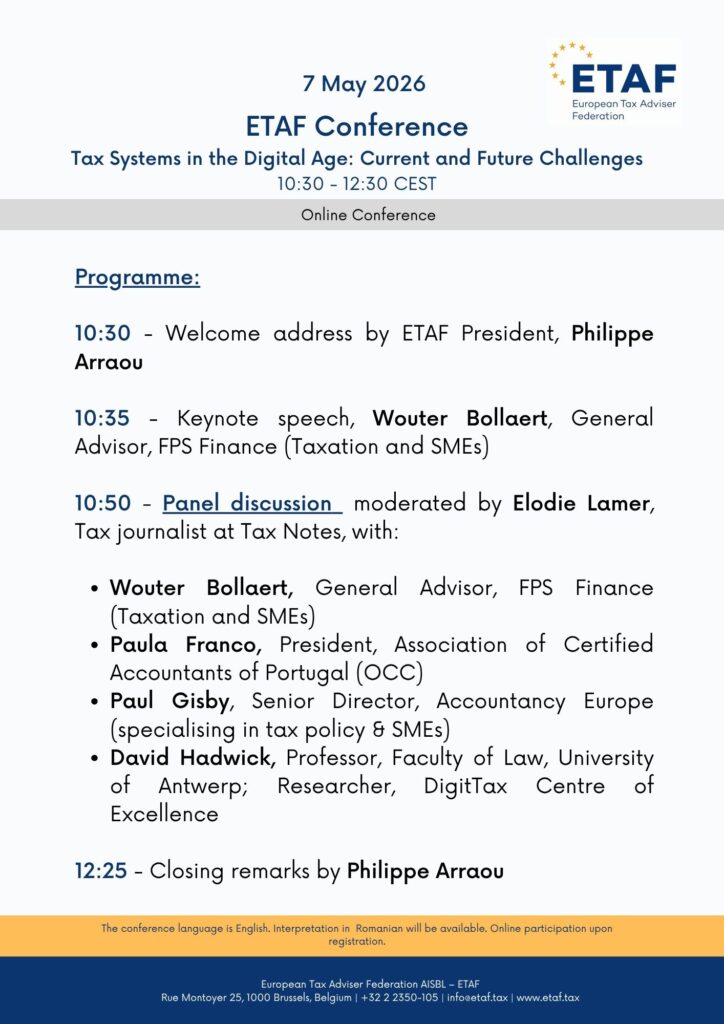
Register now: https://sweapevent.com/ETAF7May2026Conference